Key takeaways
- Activated charcoal is the best-documented binder for acute poisonings — it is on the WHO Essential Medicines list — but it binds metals like iron and lithium poorly and also binds medications and nutrients.
- Zeolite (clinoptilolite) works by ion exchange, trapping positively charged ions like lead and ammonium in a cage-like crystal. Human data is limited; purity testing matters more than brand.
- Bentonite / calcium montmorillonite clay has the best human trial data for binding aflatoxin (a mold toxin), but clays can carry lead — the FDA has warned about at least one clay product.
- All three: take them at least 2 hours away from medications and supplements, drink extra water, and buy only third-party-tested products.
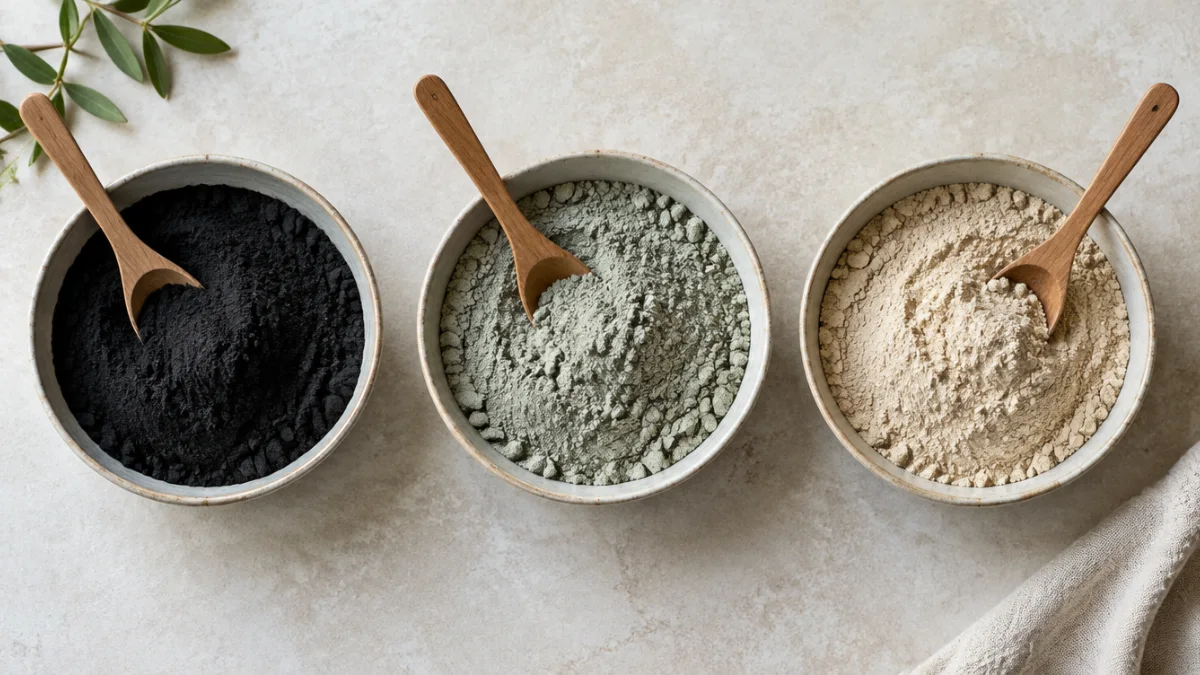
“Binders” are the backbone of almost every detox protocol you will find online. The idea is simple: swallow something that is not absorbed by the gut, and let it grab toxins on the way through so they leave in the stool instead of being reabsorbed. The three most popular binders — activated charcoal, zeolite and bentonite clay — are often sold as if they are interchangeable. They are not. They work by different mechanisms, they bind different things, and the evidence behind each one is very different.
Here is what each one actually does, what the research does and does not show, and how to choose.
Comparison table: zeolite vs charcoal vs bentonite
| Activated charcoal | Zeolite (clinoptilolite) | Bentonite clay | |
|---|---|---|---|
| What it is | Carbon heated to create a huge porous surface | Volcanic aluminosilicate mineral with a cage structure | Layered volcanic-ash clay (mostly montmorillonite) |
| How it binds | Adsorption — molecules stick to its surface | Ion exchange — swaps harmless ions for positively charged ones | Adsorption + ion exchange between its layers |
| Best documented for | Acute drug and chemical overdoses (hospital use) | Ammonium and heavy-metal ions (lab and animal data); animal feed | Aflatoxin (mold toxin) — human trials |
| Binds metals well? | Poorly (e.g. iron, lithium) | Yes, its main strength | Moderately |
| Binds meds/nutrients? | Strongly — biggest drawback | Some minerals | Some meds and minerals |
| Main risk | Constipation; blocks medications | Contamination in low-grade products | Lead contamination in some clays |
| Best use case | Short-term, occasional use | Longer, gentle daily protocols | Mold/mycotoxin-focused protocols |
Activated charcoal: powerful, but not for everything
Activated charcoal is the only one of the three that is a mainstream hospital treatment. It is on the World Health Organization’s Model List of Essential Medicines as an antidote, and emergency departments use it for certain oral overdoses when the patient arrives early enough. Its enormous internal surface area lets it grab many organic molecules — drugs, pesticides, some plant toxins.
What most detox articles leave out: charcoal is a poor binder for metals such as iron and lithium, and for alcohols. So if your concern is heavy metals, charcoal is the weakest pick of the three. It also binds medications, birth-control pills and nutrients just as happily as toxins, and it commonly causes constipation and black stools.
Use it for: short, occasional use — for example a few days after a known exposure — and never within 2 hours of medication.
Zeolite (clinoptilolite): the ion-exchange specialist
Clinoptilolite is a natural zeolite with a honeycomb of tiny channels carrying a negative charge. Those channels hold loosely bound “exchangeable” ions like calcium, potassium and sodium. When a positively charged ion that fits better comes along — lead, cadmium, ammonium — the zeolite can swap it in. That is why it is widely used for water filtration, why it is authorized in the EU as an animal-feed additive, and why it became popular as a detox supplement.
Honest caveat: most of the evidence comes from lab, environmental and animal studies. Human clinical data exists but is small. And because zeolite is a mined mineral, raw material can contain lead or other impurities — which is exactly why purity testing is the single most important buying factor. We cover what to look for in Is Zeolite Safe? Purity, Contamination Risks & How to Choose.
Use it for: gentle, longer-term protocols focused on metals, with a product that publishes a third-party heavy-metal test. See our 2026 zeolite supplement comparison for tested options.
Bentonite clay: the best human data — for mold toxins
Bentonite is a clay made largely of montmorillonite. A specific refined calcium montmorillonite has been tested in human trials in West Africa, where people eat foods commonly contaminated with aflatoxin. In those studies, taking the clay with meals lowered aflatoxin markers in blood and urine compared to placebo. That makes clay the binder with the strongest human evidence — but for mold toxins specifically, not for “detox” in general.
The risk is contamination. Clays are dug from the ground and can carry lead and arsenic. In 2016 the FDA warned consumers not to use a bentonite clay product sold for internal use after testing found elevated lead levels. If you use clay, use a food-grade product with published heavy-metal testing.
Use it for: mold- and mycotoxin-focused protocols.
Can you combine binders?
Many protocols rotate or combine them to cover more ground — for example zeolite for metals plus clay for mycotoxins. That is reasonable in principle because they bind different things, but combining also increases the risk of constipation and of binding your medications and minerals. If you combine, start one at a time, keep doses modest, drink plenty of water, and talk with a healthcare provider if you take any prescription medication.
How to take any binder safely
- Timing: at least 2 hours away from medications, supplements and your main mineral-rich meals.
- Water: drink a full glass with each dose and extra through the day.
- Bowels: if you become constipated, stop or reduce — binders only help if they leave the body.
- Testing: only buy products with a published third-party heavy-metal analysis.
- Who should not self-dose: pregnant or breastfeeding women, children, and anyone on critical medications (thyroid, seizure, heart, blood thinners, birth control) without professional advice.
Want the full zeolite protocol we use?
Step-by-step timing, dosing and the tested product we recommend.
See the Detox ProtocolFrequently asked questions
Which is better for heavy metals: zeolite or activated charcoal?
Zeolite. Its ion-exchange structure is designed to trap positively charged metal ions, while activated charcoal binds most metals poorly.
Is bentonite clay the same as zeolite?
No. Both are volcanic minerals, but bentonite is a layered clay and zeolite is a crystalline cage structure. They bind different substances and have different evidence behind them.
Can I take a binder every day?
Zeolite and clay are often used daily in short cycles; charcoal is generally meant for short-term use because it binds nutrients and medications. Always separate binders from medications by at least 2 hours.
What are the side effects of binders?
The most common is constipation. Others include bloating and, with charcoal, black stools. The bigger hidden risk is contamination in low-quality zeolite and clay products.
This article is for educational purposes and is not medical advice. Talk with a qualified healthcare provider before starting any detox protocol, especially if you take medication or have a medical condition.