This is the companion to our zeolite detox guide — the deep-dive on how the mechanism works, what’s genuinely established, and where the old claims about it fall apart. If you want the practical how-to (dosage, forms, safety), start with the guide. This post is about the science.
Fair warning: this post corrects several claims that used to live on this very page. The old version repeated vendor marketing as fact. This one doesn’t.
The Cage: What Zeolite Actually Is
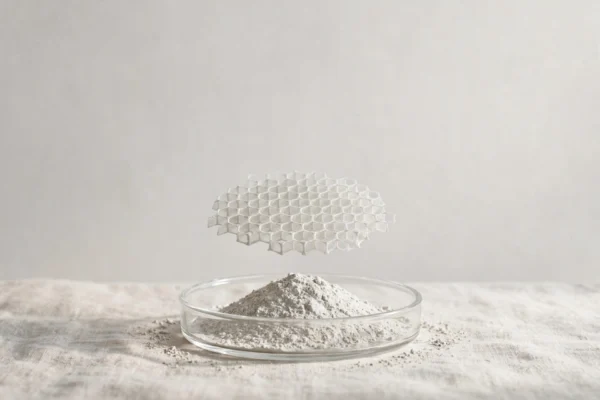
Zeolite — specifically clinoptilolite, the type used in supplements — is a volcanic mineral with a rigid, cage-like crystal structure. Picture a microscopic honeycomb: a three-dimensional lattice of silicon and aluminum oxides, full of channels and cavities.
The key detail: the aluminum atoms in that lattice carry a negative charge. That gives the whole structure a net negative charge, which means it attracts positively charged ions — cations. The cages arrive loaded with harmless ones (sodium, potassium, calcium, magnesium). When heavier, more strongly attracted ions come along — lead, cadmium, mercury, ammonium — the zeolite swaps: harmless minerals out, heavy metals in. That’s cation exchange, and it’s standard chemistry, not a proprietary discovery.
The mineral itself isn’t absorbed. It travels through your digestive tract, does its swapping in the gut, and leaves in your stool. Everything about zeolite’s mechanism flows from those two facts: it’s a charged cage, and it stays in the gut.
What Zeolite Genuinely Binds
Heavy metals. This is the best-supported claim. The binding of lead, cadmium, mercury, and similar ions by clinoptilolite is established chemistry — demonstrated at industrial scale for decades, not just in supplement marketing. Small human pilot trials on clinoptilolite supplementation show increased urinary excretion of certain metals. The trials are small and more research is needed, but the direction is consistent and the mechanism is real.
Ammonium. Well-documented, including in agriculture where clinoptilolite is an approved feed additive. The gut-ammonia binding is one of the more solid secondary effects.
Radioactive cesium and strontium. Here’s where the Fukushima story belongs — accurately. After Chernobyl and Fukushima, clinoptilolite was deployed to capture radioactive isotopes from contaminated water. That’s industrial water treatment: tons of mineral filtering millions of gallons. It proves the binding mechanism works on those isotopes. It does not prove that a teaspoon of powder detoxes radiation from your body. Anyone using the Fukushima cleanup as proof their supplement works is confusing water filtration with human physiology.
What Zeolite Does NOT Do
The old version of this page made several claims that need direct correction:
It does not cross the blood-brain barrier. The old post claimed a “water-soluble” zeolite could enter the brain and pull toxins from it. There is no evidence for this. Clinoptilolite is not absorbed into the bloodstream in any meaningful quantity — it stays in the digestive tract. Any detox effect is gut-level. Period.
It is not “water-soluble.” That was vendor terminology from a specific brand’s marketing. Clinoptilolite doesn’t dissolve in water — it suspends in it. The distinction matters because “water-soluble” was used to imply it circulates systemically. It doesn’t.
It does not remove graphene oxide. No human data, no clinical studies, no plausible demonstrated mechanism. The old post hedged (“we cannot claim… however, it seems logical”) while strongly implying it. Let’s be plain: there is no evidence.
It does not bind viruses or “boost your immune system” by removing viral particles. No clinical support. In-vitro speculation at best.
It does not “increase cellular hydration,” “carry nutrients to where they’re most needed,” or “balance your pH to 7.35–7.45.” These were vendor claims with no scientific basis. Your blood pH is regulated by your lungs and kidneys, not by mineral powder.
It is not “100% safe and non-toxic at any level.” No substance is. The old post’s safety claims — including “safe to take with most medications” — were dangerous. Zeolite can interfere with medication absorption; that 2-hour separation rule exists for a reason. See the safety guide for the full picture.
Glyphosate binding is unproven. The old post cited a “Dr. Huber from Perdue University” claiming clinoptilolite binds glyphosate. Setting aside the misspelled university, this claim has no published clinical evidence behind it. It may be plausible chemistry; it is not demonstrated fact.
Why the Old Claims Persist
A frank note on why this page used to say all of that: most zeolite content online is written by sellers, and sellers compete on claims, not accuracy. “Binds heavy metals in the gut” doesn’t sell as well as “systemically cleanses your entire body including your brain.” The result is an information environment where the honest mechanism — a genuinely interesting bit of chemistry with modest, real applications — gets buried under layers of marketing escalation.
The irony is that the real story is good enough. A volcanic mineral with a negatively charged cage structure that swaps heavy metals out of your digestive tract is genuinely remarkable. It doesn’t need to also cure Lyme disease and remove graphene to be worth knowing about.
The Bottom Line on the Mechanism
- Zeolite (clinoptilolite) is a negatively charged, cage-structured mineral. That part is real chemistry.
- In the gut, it exchanges harmless minerals for heavy metals and ammonium via cation exchange. That part is demonstrated.
- It stays in the digestive tract. It doesn’t enter the bloodstream, cross the blood-brain barrier, or cleanse organs. Anyone telling you otherwise is selling something.
- The Fukushima story proves the binding works on radioactive isotopes in water treatment — not that supplements detox radiation from your body.
- Everything beyond gut-level binding of metals and ammonium is speculation sitting on a spectrum from “plausible but unproven” to “made up by marketing departments.”
For the practical side — forms, dosage, timing, the safety issues sellers skip, and how to choose a clean product — read the full zeolite detox guide.
Frequently Asked Questions
Does zeolite actually remove heavy metals from the body?
The binding chemistry is well-established and small human trials show positive signals for increased metal excretion. It works at the gut level — binding metals in the digestive tract. Claims beyond that outrun the evidence.
Can zeolite cross the blood-brain barrier?
No. There is no evidence that clinoptilolite is absorbed into the bloodstream in meaningful quantities, let alone that it crosses into the brain. It stays in the gut. Any source claiming otherwise is repeating vendor marketing.
What is the Fukushima zeolite story?
After the Chernobyl and Fukushima nuclear disasters, clinoptilolite was used to capture radioactive cesium and strontium from contaminated water — industrial-scale water filtration. It confirms the mineral binds those isotopes. It doesn’t prove oral supplements detox radiation from humans.
Is “water-soluble zeolite” different from regular zeolite?
“Water-soluble” was a specific brand’s marketing term, not a scientific category. Clinoptilolite doesn’t dissolve in water; it forms a suspension. The term was used to imply systemic absorption that doesn’t occur.
Why did this page used to make bigger claims?
The previous version repeated manufacturer and affiliate marketing copy as fact. This rewrite corrects the record based on what the chemistry and published evidence actually support.
This article is for educational purposes only and isn’t medical advice. Talk to a qualified health professional before using zeolite or any supplement, especially if you take prescription medications.